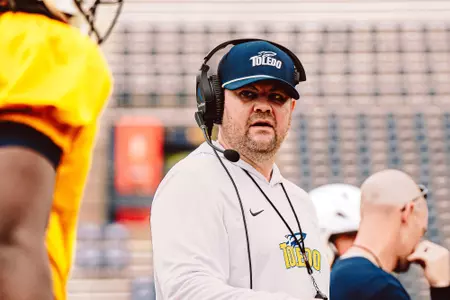
Toledo offensive coordinator and quarterbacks coach Cris Reisert was previously the head coach at Tiffin and Gardner-Webb.
Photo by: Bree Bee
Cris Reisert gave up being a head coach to lead the Toledo offense
8/26/2026 2:00:00 PM | Football
Former Tiffin, Gardner-Webb head coach is back to calling plays
TOLEDO, Ohio — Cris Reisert has spent much of his football career taking the long way around.
So perhaps it shouldn't be surprising that when Toledo came calling, Reisert was willing to take a step back in title to take a step forward in opportunity.
Reisert left Gardner-Webb, where he had been the head coach, to become Toledo's offensive coordinator and quarterbacks coach. It meant giving up the title of head coach, but it also brought him home to Ohio, into a program he had admired for years and back to the part of football he enjoys most: solving problems.
"When Coach called about the opportunity, it wasn't like, 'Hey, let me and my wife discuss it and I'll get back to you,'" said Reisert. "We knew that this was an easy decision to want to do this."
Toledo coach Mike Jacobs saw value in Reisert that extended well beyond his work with the offense.
"Cris brings tremendous experience and knowledge from his time as a head coach," said Jacobs. "He has proven to be a vital sounding board for me and has had a major influence on the culture and identity of our program."
That role fits Reisert, whose career has been built around learning different parts of the game and finding ways to make programs better.
"I wanted to be able to solve problems," he said.
The approach dates to Reisert's playing days. A quarterback at powerhouse Cincinnati Moeller, Reisert rotated as a junior before becoming the starter as a senior. When it came time to choose a college, he bypassed more established programs for Ohio Dominican, which was entering only its second season of football after going 0-10.
Reisert saw an opportunity.
"I wanted to go somewhere to leave a legacy rather than be the next quarterback," he said. "I wanted to go and kind of leave a footprint and leave a place better than I found it."
He rotated through Ohio Dominican's first three games before taking over as the starter and holding the job for the rest of his career. The Panthers went from 0-10 to a nationally ranked program, eventually climbing as high as the top five.
Reisert's interest in coaching began taking shape during those years. After his sophomore season, he was an All-American and started a summer passing camp in Cincinnati. He worked with quarterbacks, running backs, tight ends and receivers and watched young players change over the course of the summer.
The football improved. And so did the players' confidence.
"I just started to get the itch that maybe this was the direction I was supposed to go," said Reisert.
After his senior season, Reisert stayed at Ohio Dominican as a defensive graduate assistant.
Then came his first recruiting assignment.
"How do I recruit?" asked Reisert.
"You'll figure it out," was the response.
So he did.
At Ohio Dominican, Reisert finished his master's degree and got a Ph. D. in coaching from Bill Conley, a former long-time Ohio State assistant, whom Reisert credits as an important influence.
Next came Ball State, where Reisert was an offensive line GA.
"I always wanted to be a coordinator, wanted to be a head coach," he said. "And I didn't want to be one of those guys that, like, hey, there's a problem, you go fix it. I wanted to be able to solve problems."
The path continued through Elon, where he coached tight ends and recruited, and spent time under Curt Cignetti. When Ohio Dominican offered Reisert its offensive coordinator position, he returned.
Two years later, at age 29, he became the head coach at Tiffin. The Dragons went 40-11 in five seasons, won three conference championships and ended a 28-year drought against Findlay.
Reisert parlayed that success into the head job at Gardner-Webb, inheriting a program with just 38 players and one returning starter.
The Runnin' Bulldogs went 4-8 in Reisert's first season. The next year, they went 7-5 — their most wins since 2003.
Then Toledo called.
Reisert had long respected Jacobs, whose own coaching career had followed a similarly unconventional journey. The two had crossed paths over the years but never worked together.
Reisert admired how Jacobs had built programs. He also had a personal connection to UT, attending camps as a youngster. As Reisert's coaching career developed, Toledo remained one of those jobs he viewed as a destination.
"Coach always talks about putting Toledo on a pedestal," said Reisert. "I've always done that. I didn't need to start doing that."
Reisert never viewed the move as a demotion. As a head coach, he had been responsible for an entire program. At Toledo, he could concentrate more fully on football and on coaching the offense. It also allowed him to get back to calling plays.
Reisert previously called plays at Tiffin and during his first season at Gardner-Webb. Eventually, the demands of being a head coach became too much.
Now, he can focus on the offense. That's where Reisert feels most at home.
As a college quarterback, he wasn't the biggest, fastest or most physically talented player on the field. He didn't have the strongest arm. He had to find another way to win.
"I had to win mentally," he said. "I had to win strategically and find ways to influence the game in a positive way that didn't involve physical talent."
As a coach, he gets to take that approach and apply it to an entire offense, helping 11 players find an advantage and pursue the same vision.
For Reisert, the journey from Cincinnati to Ohio Dominican, from graduate assistant to head coach and now from Gardner-Webb back to Ohio has never really been about titles. It has been about building.
He chose Ohio Dominican because he wanted to leave it better than he found it.
He chose coaching because he discovered he could help young players find confidence.
He became a coordinator because he wanted to solve problems.
And he came to Toledo because he saw another opportunity to build.
The stage is bigger now, but the mission remains the same.
So perhaps it shouldn't be surprising that when Toledo came calling, Reisert was willing to take a step back in title to take a step forward in opportunity.
Reisert left Gardner-Webb, where he had been the head coach, to become Toledo's offensive coordinator and quarterbacks coach. It meant giving up the title of head coach, but it also brought him home to Ohio, into a program he had admired for years and back to the part of football he enjoys most: solving problems.
"When Coach called about the opportunity, it wasn't like, 'Hey, let me and my wife discuss it and I'll get back to you,'" said Reisert. "We knew that this was an easy decision to want to do this."
Toledo coach Mike Jacobs saw value in Reisert that extended well beyond his work with the offense.
"Cris brings tremendous experience and knowledge from his time as a head coach," said Jacobs. "He has proven to be a vital sounding board for me and has had a major influence on the culture and identity of our program."
That role fits Reisert, whose career has been built around learning different parts of the game and finding ways to make programs better.
"I wanted to be able to solve problems," he said.
The approach dates to Reisert's playing days. A quarterback at powerhouse Cincinnati Moeller, Reisert rotated as a junior before becoming the starter as a senior. When it came time to choose a college, he bypassed more established programs for Ohio Dominican, which was entering only its second season of football after going 0-10.
Reisert saw an opportunity.
"I wanted to go somewhere to leave a legacy rather than be the next quarterback," he said. "I wanted to go and kind of leave a footprint and leave a place better than I found it."
He rotated through Ohio Dominican's first three games before taking over as the starter and holding the job for the rest of his career. The Panthers went from 0-10 to a nationally ranked program, eventually climbing as high as the top five.
Reisert's interest in coaching began taking shape during those years. After his sophomore season, he was an All-American and started a summer passing camp in Cincinnati. He worked with quarterbacks, running backs, tight ends and receivers and watched young players change over the course of the summer.
The football improved. And so did the players' confidence.
"I just started to get the itch that maybe this was the direction I was supposed to go," said Reisert.
After his senior season, Reisert stayed at Ohio Dominican as a defensive graduate assistant.
Then came his first recruiting assignment.
"How do I recruit?" asked Reisert.
"You'll figure it out," was the response.
So he did.
At Ohio Dominican, Reisert finished his master's degree and got a Ph. D. in coaching from Bill Conley, a former long-time Ohio State assistant, whom Reisert credits as an important influence.
Next came Ball State, where Reisert was an offensive line GA.
"I always wanted to be a coordinator, wanted to be a head coach," he said. "And I didn't want to be one of those guys that, like, hey, there's a problem, you go fix it. I wanted to be able to solve problems."
The path continued through Elon, where he coached tight ends and recruited, and spent time under Curt Cignetti. When Ohio Dominican offered Reisert its offensive coordinator position, he returned.
Two years later, at age 29, he became the head coach at Tiffin. The Dragons went 40-11 in five seasons, won three conference championships and ended a 28-year drought against Findlay.
Reisert parlayed that success into the head job at Gardner-Webb, inheriting a program with just 38 players and one returning starter.
The Runnin' Bulldogs went 4-8 in Reisert's first season. The next year, they went 7-5 — their most wins since 2003.
Then Toledo called.
Reisert had long respected Jacobs, whose own coaching career had followed a similarly unconventional journey. The two had crossed paths over the years but never worked together.
Reisert admired how Jacobs had built programs. He also had a personal connection to UT, attending camps as a youngster. As Reisert's coaching career developed, Toledo remained one of those jobs he viewed as a destination.
"Coach always talks about putting Toledo on a pedestal," said Reisert. "I've always done that. I didn't need to start doing that."
Reisert never viewed the move as a demotion. As a head coach, he had been responsible for an entire program. At Toledo, he could concentrate more fully on football and on coaching the offense. It also allowed him to get back to calling plays.
Reisert previously called plays at Tiffin and during his first season at Gardner-Webb. Eventually, the demands of being a head coach became too much.
Now, he can focus on the offense. That's where Reisert feels most at home.
As a college quarterback, he wasn't the biggest, fastest or most physically talented player on the field. He didn't have the strongest arm. He had to find another way to win.
"I had to win mentally," he said. "I had to win strategically and find ways to influence the game in a positive way that didn't involve physical talent."
As a coach, he gets to take that approach and apply it to an entire offense, helping 11 players find an advantage and pursue the same vision.
For Reisert, the journey from Cincinnati to Ohio Dominican, from graduate assistant to head coach and now from Gardner-Webb back to Ohio has never really been about titles. It has been about building.
He chose Ohio Dominican because he wanted to leave it better than he found it.
He chose coaching because he discovered he could help young players find confidence.
He became a coordinator because he wanted to solve problems.
And he came to Toledo because he saw another opportunity to build.
The stage is bigger now, but the mission remains the same.

Sunday, September 13
Monday, September 07
Monday, August 31
Wednesday, February 04