Players Mentioned
F
/ Women's Basketball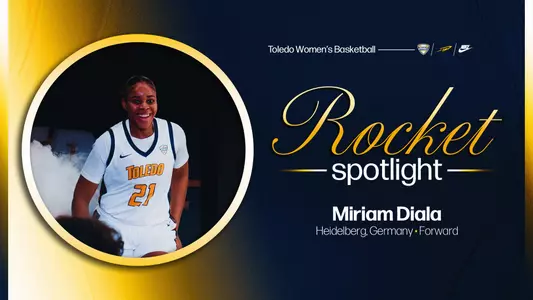
Miriam Diala is a sophomore forward for the Toledo women's basketball team from Heidelberg, Germany.
Rocket Spotlight on Miriam Diala
12/20/2025 12:32:00 PM | Women's Basketball
On competing internationally, adjusting to U.S. college basketball and her interest in medical research and epidemiology
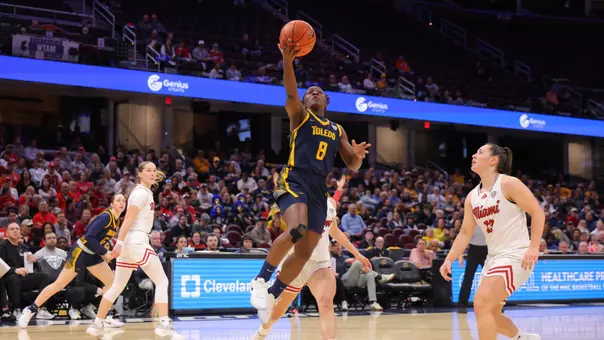
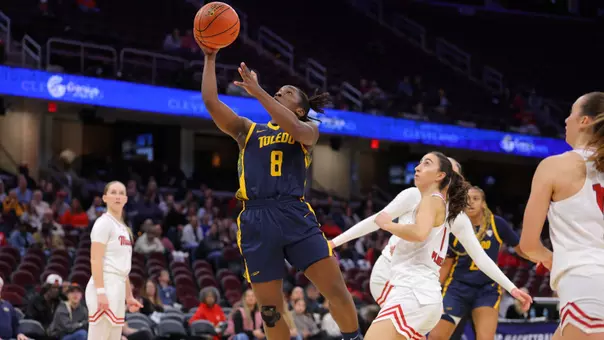
Miriam Diala is a sophomore forward on the Toledo women's basketball team from Heidelberg, Germany. She transferred from George Washington University after playing in 22 games and starting four as a freshman last season. She has started all nine games for Toledo this season, averaging 6.7 points and 4.6 rebounds. Diala has also competed in several international competitions with Team Germany, most recently at the FIBA U20 over the summer.
On growing up in Heidelberg, Germany and beginning her basketball career
Germany wasn't really a basketball country when I was growing up. It was all soccer. My brother and I tried different sports and he landed on basketball, and that is how I came across basketball. I was introduced to basketball at the age of five. I did other sports too, but the one sport that really stuck was basketball. I played soccer before I played basketball. I also played tennis for around five years and then I put all my focus on basketball around age 12-13.
On when she first considered playing in the United States
I was introduced to it (the possibility of playing U.S. college basketball) at the age of 16. Before then, I didn't even know that was something I could pursue. My club team was attached to the German national team and seeing German players older than me going that route such as Satou Sabally (Oregon/Phoenix Mercury) and Nyara Sabally (Oregon/New York Liberty) showed that it's possible to go the U.S. route and play college basketball. I put my mind to it that that was something that I wanted to do, and a goal I wanted to achieve.
I didn't really have interest in playing in other countries. I talked about the opportunities in Europe with my national team coach, because many players play in countries like France, Czech Republic and Portugal. But that wasn't really a goal of mine because once I was introduced to the idea of playing NCAA basketball, I was determined to reach that goal and didn't want to go to other countries.
On how she started playing with Germany's national teams
It started in our states. I'm from Baden-Württemberg. In our states, you get elected to represent your state and go to tournaments within Germany, and that's when national team coaches recruit you. I then experienced all the training camps in the summer -- intense training camps -- and just saw how much I can improve in such a short amount of time if I practice consistently and hard at a high level. Also having the summers with tournaments and playing against the best of other countries, that was a great opportunity to measure myself as a player and where we are as a country. Competing internationally and having the opportunity to play multiple European Championships and two World Cups, that is something that really sticks. Having the opportunity to play countries outside of Europe allowed me to see different styles of play. I got to play against the U.S., and that was a harsh reality check, but it was cool because you got to compete with the best.
On what is needed to compete against the U.S.
I think we learned that we as Germany still have a long way to go. We have a lot of talent, but how we practice and how we do things needs to improve to compete on that level. What you are taught in European basketball is your basketball IQ and understanding the game. So now, we understand the game, but we as a country need to improve our skills to compete and create the balance between IQ and skills in order to compete with countries like the U.S. The IQ part, understanding the game and playing the game to its fullest, that helps us against Europe and internationally, but the U.S. is still a few steps ahead skill-wise.
On the differences between international and American basketball
One big difference is that the shot clock is operated in a 24-second, 14-second way in FIBA and not in a 30- and 20-second way in college basketball. That is a huge adjustment which means that in international basketball, you have less time for your offense, or in general you just have less time on the clock. We still do four quarters, 10 minutes each, but the pace is different and there's less time to set up the offense. So, I think the time regulations have been an adjustment and a difference. Even though we have less time in Europe or internationally, the pace here is faster.
I would also say the way referees operate is different. I feel like internationally, you are allowed to be much more physical than here. That is something that took me a few games to get used to, coming here and having to adjust to the level of physicality, what is allowed, what is legal and illegal.
It's not something I can switch on and switch off. It takes me more time, some games, to really adjust and get myself right. The first two games, I was in foul trouble because I just didn't adjust fast enough. I can't change the way the game is officiated here and I can't change the way the games are officiated in Europe, but what I can change is my pace of adjustment to the how the games are officiated and things like that.
On playing in the FIBA U20 in summer 2025
It was a good experience. We had a really long and intense preparation and training camp. In a timespan of two months, we were at home for only two days. It was a really intense program. Going to the European Championship, I felt that our team was prepared, but at the end of the day, we just fell short in the important games. In European Championships or FIBA Championships in general, it's not about how many games you win, it's about which games are you winning. You could win every game and lose the important ones, which would place you lower than you usually would be. That happened to us. We didn't start the tournament well, so we slipped to the bottom of the ranks and placed 9-16 for half of the tournament because we just lost the important games. Other teams that should have won the games did not win, which shifted the whole placements so we finished ninth because we won all the games after losing that important game, which determined if we were playing for the championship or the places below.
On navigating the transfer portal after a season at George Washington
The transfer portal was a very exhausting period, but I think that goes for every athlete. During my transfer portal time, Coach Ginny came into contact with me. I had my visit here and I just felt at home. I committed one day after my visit because I felt like it was the right move. Coming here, I was nervous. Even though Toledo is my second college, I transferred for a reason. I was nervous to see if everything I wished for would be real too.
On the positive outcomes after arriving at Toledo
Coming here, I was shocked in a positive way, especially how well I fit in people-wise. The first few weeks, there wasn't a lot of team basketball. We had a lot of individual and position group practices, but not a lot of team practices. I did not know how I would align basketball-wise, but I knew from the people that Toledo was a fit because I felt at home. People just made me feel like I am in the right spot. The coaches have been amazing since I've been here. It feels like I've known my teammates for years. When we got on the court, it took a lot of adjustment to get to know each other, know someone's sweet spots, what they like to do. We're still not there yet, we still need to find each other more and help each other out on the court. But just to know the chemistry that we have off the court just gives me so much hope and shows that we have so much potential to bring that chemistry on the court and transform that into good outcomes.
On her education at Toledo and her future in medical research
I'm currently majoring in public health. With that, I want to go into research. I don't know what kind of research yet, maybe cancer research. When I was in Germany, I had a four-month internship in a cancer research center and I really liked that.
What I like about the public health major is there is a lot I can do research-wise. I also thought about going into epidemiology just to research some diseases, outbreaks and stuff like that. There's a lot that I'm still learning about my major and some different interests have been sparked. Research and epidemiology are two things that I am considering.
On her future plans after graduating
Right now, I just want to see how things go basketball-wise, but also with my education and how things change in the world and see where we are at. I am more of a type of person to give my best effort and see what doors are open.
On growing up in Heidelberg, Germany and beginning her basketball career
Germany wasn't really a basketball country when I was growing up. It was all soccer. My brother and I tried different sports and he landed on basketball, and that is how I came across basketball. I was introduced to basketball at the age of five. I did other sports too, but the one sport that really stuck was basketball. I played soccer before I played basketball. I also played tennis for around five years and then I put all my focus on basketball around age 12-13.
On when she first considered playing in the United States
I was introduced to it (the possibility of playing U.S. college basketball) at the age of 16. Before then, I didn't even know that was something I could pursue. My club team was attached to the German national team and seeing German players older than me going that route such as Satou Sabally (Oregon/Phoenix Mercury) and Nyara Sabally (Oregon/New York Liberty) showed that it's possible to go the U.S. route and play college basketball. I put my mind to it that that was something that I wanted to do, and a goal I wanted to achieve.
I didn't really have interest in playing in other countries. I talked about the opportunities in Europe with my national team coach, because many players play in countries like France, Czech Republic and Portugal. But that wasn't really a goal of mine because once I was introduced to the idea of playing NCAA basketball, I was determined to reach that goal and didn't want to go to other countries.
On how she started playing with Germany's national teams
It started in our states. I'm from Baden-Württemberg. In our states, you get elected to represent your state and go to tournaments within Germany, and that's when national team coaches recruit you. I then experienced all the training camps in the summer -- intense training camps -- and just saw how much I can improve in such a short amount of time if I practice consistently and hard at a high level. Also having the summers with tournaments and playing against the best of other countries, that was a great opportunity to measure myself as a player and where we are as a country. Competing internationally and having the opportunity to play multiple European Championships and two World Cups, that is something that really sticks. Having the opportunity to play countries outside of Europe allowed me to see different styles of play. I got to play against the U.S., and that was a harsh reality check, but it was cool because you got to compete with the best.
On what is needed to compete against the U.S.
I think we learned that we as Germany still have a long way to go. We have a lot of talent, but how we practice and how we do things needs to improve to compete on that level. What you are taught in European basketball is your basketball IQ and understanding the game. So now, we understand the game, but we as a country need to improve our skills to compete and create the balance between IQ and skills in order to compete with countries like the U.S. The IQ part, understanding the game and playing the game to its fullest, that helps us against Europe and internationally, but the U.S. is still a few steps ahead skill-wise.
On the differences between international and American basketball
One big difference is that the shot clock is operated in a 24-second, 14-second way in FIBA and not in a 30- and 20-second way in college basketball. That is a huge adjustment which means that in international basketball, you have less time for your offense, or in general you just have less time on the clock. We still do four quarters, 10 minutes each, but the pace is different and there's less time to set up the offense. So, I think the time regulations have been an adjustment and a difference. Even though we have less time in Europe or internationally, the pace here is faster.
I would also say the way referees operate is different. I feel like internationally, you are allowed to be much more physical than here. That is something that took me a few games to get used to, coming here and having to adjust to the level of physicality, what is allowed, what is legal and illegal.
It's not something I can switch on and switch off. It takes me more time, some games, to really adjust and get myself right. The first two games, I was in foul trouble because I just didn't adjust fast enough. I can't change the way the game is officiated here and I can't change the way the games are officiated in Europe, but what I can change is my pace of adjustment to the how the games are officiated and things like that.
On playing in the FIBA U20 in summer 2025
It was a good experience. We had a really long and intense preparation and training camp. In a timespan of two months, we were at home for only two days. It was a really intense program. Going to the European Championship, I felt that our team was prepared, but at the end of the day, we just fell short in the important games. In European Championships or FIBA Championships in general, it's not about how many games you win, it's about which games are you winning. You could win every game and lose the important ones, which would place you lower than you usually would be. That happened to us. We didn't start the tournament well, so we slipped to the bottom of the ranks and placed 9-16 for half of the tournament because we just lost the important games. Other teams that should have won the games did not win, which shifted the whole placements so we finished ninth because we won all the games after losing that important game, which determined if we were playing for the championship or the places below.
On navigating the transfer portal after a season at George Washington
The transfer portal was a very exhausting period, but I think that goes for every athlete. During my transfer portal time, Coach Ginny came into contact with me. I had my visit here and I just felt at home. I committed one day after my visit because I felt like it was the right move. Coming here, I was nervous. Even though Toledo is my second college, I transferred for a reason. I was nervous to see if everything I wished for would be real too.
On the positive outcomes after arriving at Toledo
Coming here, I was shocked in a positive way, especially how well I fit in people-wise. The first few weeks, there wasn't a lot of team basketball. We had a lot of individual and position group practices, but not a lot of team practices. I did not know how I would align basketball-wise, but I knew from the people that Toledo was a fit because I felt at home. People just made me feel like I am in the right spot. The coaches have been amazing since I've been here. It feels like I've known my teammates for years. When we got on the court, it took a lot of adjustment to get to know each other, know someone's sweet spots, what they like to do. We're still not there yet, we still need to find each other more and help each other out on the court. But just to know the chemistry that we have off the court just gives me so much hope and shows that we have so much potential to bring that chemistry on the court and transform that into good outcomes.
On her education at Toledo and her future in medical research
I'm currently majoring in public health. With that, I want to go into research. I don't know what kind of research yet, maybe cancer research. When I was in Germany, I had a four-month internship in a cancer research center and I really liked that.
What I like about the public health major is there is a lot I can do research-wise. I also thought about going into epidemiology just to research some diseases, outbreaks and stuff like that. There's a lot that I'm still learning about my major and some different interests have been sparked. Research and epidemiology are two things that I am considering.
On her future plans after graduating
Right now, I just want to see how things go basketball-wise, but also with my education and how things change in the world and see where we are at. I am more of a type of person to give my best effort and see what doors are open.
Toledo Women's Basketball vs Miami Post Game Press Conference
Saturday, March 14
Toledo Women's Basketball vs Ball State Post Game Press Conference
Friday, March 13
Toledo Women's Basketball vs UMass Post Game Press Conference
Wednesday, March 11
Toledo Women's Basketball vs Central Michigan Post Game Press Conference
Thursday, February 26